
Zero® Ball Environmental Fact Sheet
Executive Summary
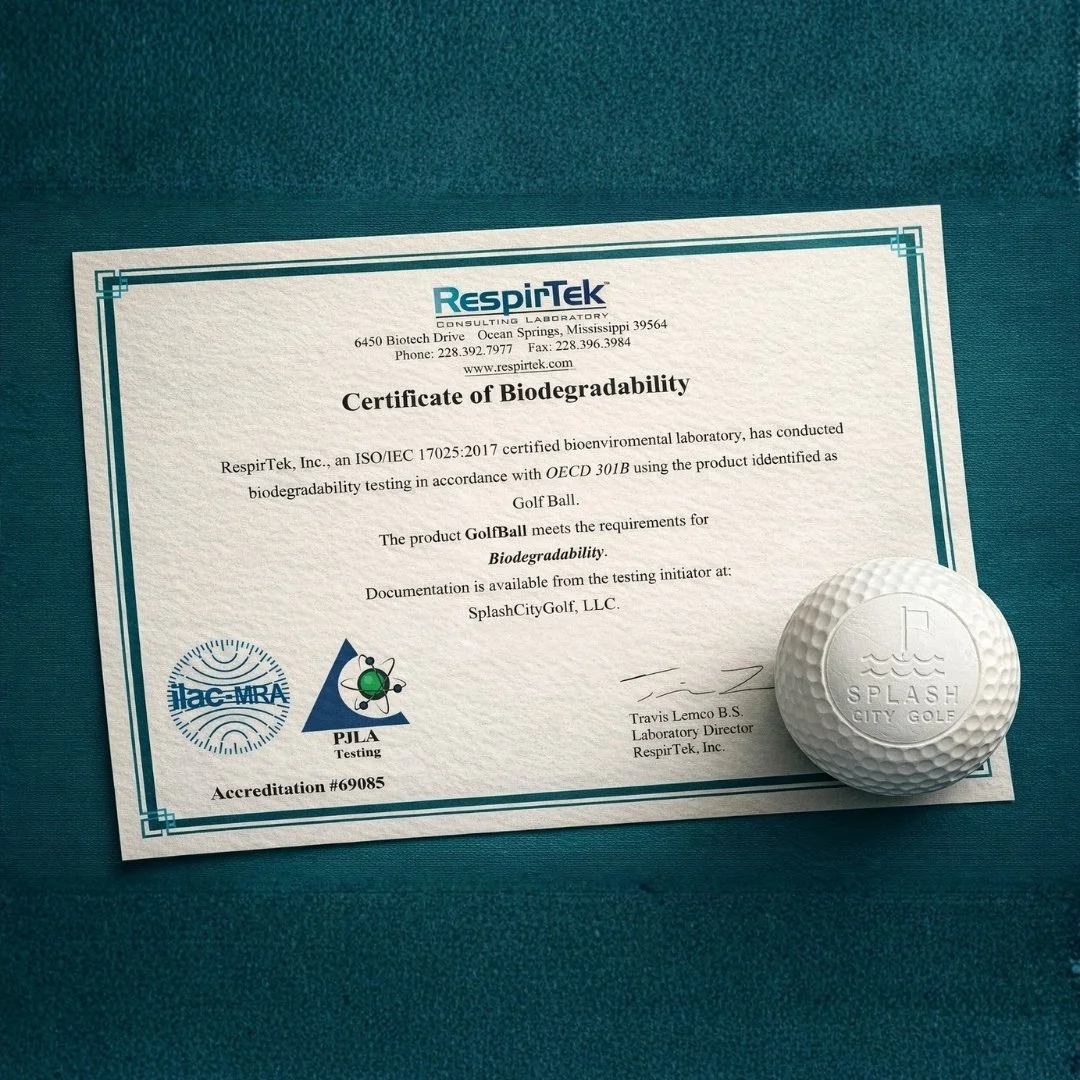
The Zero® Ball is certified biodegradable and non-toxic by RespirTek using OECD 301B methodology.
The primary ingredient, Polyvinyl Alcohol, is non-toxic and holds the EPA’s highest safety rating.
Toxicity testing confirms the Zero® Ball is non-inhibitory and safe for marine life.
The Zero® Ball fully mineralizes into carbon dioxide and water, resulting in no microplastics & marine debris.
You can download the PDF version of this report by clicking here.
contents
Biodegradability Certifications
What is OECD 301B methodology and why is it relevant?
How does OECD 301B measure the biodegradability of a substance?
What about the remaining 39.8% of the Zero® Ball
How do you know that Zero® Balls are non-toxic and safe for marine life?
What is the Zero® Ball made of?
Does the Zero® Ball create marine debris and microplastics?
zero® Ball Biodegradability Certifications
The Zero® Ball is certified biodegradable and non-toxic by RespirTek, a leading bioenvironmental testing lab based in the United States. The Zero® Ball was tested using OECD 301B methodology - an internationally recognized method for assessing biodegradability. Our product has the most robust biodegradability and non-toxicity documentation of any biodegradable golf ball on the market.
What is OECD 301B Methodology and why is it relevant?
The Organisation For Economic Co-Operation and Development (OECD) sets standardized guidelines for testing chemical safety, including biodegradability. OECD testing protocols are developed through international consensus across 38 member countries, including the United States of America and various countries across Europe and Asia. The OECD 301B methodology determines the Ready Biodegradability of a substance by measuring the amount of carbon dioxide produced as micro-organisms break it down under aerobic conditions. We consider this the premier methodology for testing the biodegradability of a substance.
How does OECD 301B Measure the Biodegradability of a Substance?
OECD 301B guidelines state that a substance officially achieves Ready Biodegradability if it reaches a threshold of 60% biodegradation. This must be achieved before the substance reaches a plateau, defined as three consecutive sampling events showing no increase in biodegradation. The Zero® Ball achieved a maximum biodegradability of 60.2% in testing conducted by Respirtek. Because the Zero® Ball surpassed the 60% threshold, it is officially classified as Biodegradable under the OECD 301B methodology.
What about the remaining 39.8% of the zero® ball?
It is a common misconception that a 60.2% biodegradability result implies that the remaining 39.8% of the ball is non-biodegradable or persistent. In the context of OECD 301B, the 60% threshold is the “pass level” for ultimate biodegradation. This accounts for the fact that microorganisms use a portion of the organic carbon to build new biomass (cell growth) instead of exhaling it as carbon dioxide. Achieving greater than a 60% result is scientifically accepted as proof that the material has been fully integrated into the biological cycle and will continue to mineralize completely in the environment.
HOW DO YOU KNOW THAT ZERO® BALLS ARE NON-TOXIC & SAFE FOR MARINE LIFE?
OECD 301B contains a toxicity control. In laboratory testing, our Zero® Ball was mixed with a known biodegradable reference. Microorganisms (bacteria) are used because their high surface-area-to-volume ratio makes them extremely sensitive to chemical toxins. Results show that the toxicity control achieved 66.8% biodegradation by Day 14, far exceeding the 25% threshold required to confirm the substance as not inhibitory or toxic. If the bacteria thrive at the concentration levels found in test conditions, it establishes a significant safety margin for larger, more complex organisms like fish and invertebrates encountering the Zero® Ball at vastly lower concentrations in the open water.
WHAT IS THE ZERO® BALL MADE OF?
Polyvinyl Alcohol (PVA) is the primary ingredient of the Zero® Ball. PVA is a biodegradable, water soluble, and non-toxic material found in everyday products such as medicine coatings and laundry pods. The United States Environmental Protection Agency lists PVA as a Safer Choice Green Circle ingredient, which is the EPA’s highest safety rating for human health and the environment. Furthermore, standardized ecotoxicity studies (OECD 202 and 203) for fish and invertebrates consistently show PVA LC50 thresholds > 100 mg/L (source: ECHA Registration Dossier for Polyvinyl Alcohol), which the EPA defines as practically non-toxic.
DOES THE ZERO® BALL CREATE MARINE DEBRIS & MICROPLASTICS?
Marine debris implies a a persistent physical hazard. The mechanical properties of the Zero® Ball specifically prevent them from being classified as marine debris, as the golf ball begins to lose structural integrity upon immediately interacting with seawater. The Zero® Ball is engineered to be truly biodegradable, meaning they undergo a complete molecular breakdown rather than fragmenting into smaller pieces. Because microorganisms recognize our product as a food source and convert it directly into CO2 and water, it does not create or contribute to microplastic pollution. This ensures that once the ball begins disintegrating, it is on a definitive path to full mineralization.